News & Blog
Introduction
Healthcare services are expanding rapidly across India, creating an increasing demand for trained healthcare support professionals. Along with doctors, nurses, laboratory professionals, physiotherapists, and other allied healthcare workers, there is also a growing need for individuals who understand primary healthcare, community health awareness, basic patient care, preventive healthcare, and essential medicines within the scope of their education and applicable laws.
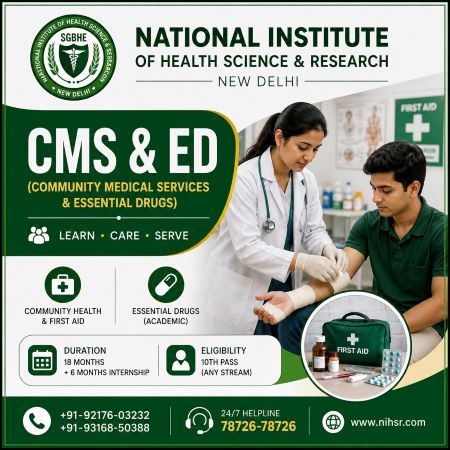
The Community Medical Services & Essential Drugs (CMS & ED) course is a skill-oriented vocational programme designed to provide learners with fundamental knowledge of community healthcare, health education, disease prevention, first aid, basic pharmacology, patient care, and healthcare support.
This guide explains everything you need to know about the CMS & ED course, including eligibility, duration, curriculum, practical training, career opportunities, important legal considerations, and frequently asked questions.
What is CMS & ED?
CMS & ED is a vocational healthcare programme that introduces students to the fundamentals of community healthcare and essential drugs.
The course focuses on developing knowledge and practical skills related to:
- Community health awareness
- Preventive healthcare
- Basic patient care
- First aid
- Health education
- Hygiene and sanitation
- Essential medicines (academic understanding)
- Public health programmes
The programme is intended to improve healthcare knowledge and support skill development. It is not a substitute for MBBS or any other statutory medical qualification.
Full Form of CMS & ED
CMS – Community Medical Services
ED – Essential Drugs
The course combines concepts of community healthcare with an understanding of commonly used essential medicines from an educational perspective.
Objectives of the Course
The primary objectives of the CMS & ED course are:
- Develop awareness of community healthcare.
- Understand basic concepts of human health and disease.
- Promote preventive healthcare.
- Learn first aid and emergency response.
- Understand nutrition and hygiene.
- Build communication skills for patient interaction.
- Learn healthcare documentation.
- Understand the role of essential medicines.
- Develop healthcare support skills.
- Promote ethical healthcare practices.
- Prepare learners for vocational healthcare support roles.
Who Should Join?
This course may be suitable for:
- Students after 10th
- Students interested in healthcare careers
- Individuals seeking vocational healthcare education
- Healthcare volunteers
- NGO workers
- Rural healthcare awareness workers
- Community health educators
- Individuals planning self-employment in healthcare-related services (subject to applicable laws)
- Students preparing for further healthcare education
Eligibility
Educational Qualification
Passed 10th (Matriculation) or equivalent.
Candidates should verify the latest eligibility requirements prescribed by the institution before applying.
Duration
At NIHSR, the CMS & ED programme is offered with the following structure:
- Course Duration: 18 Months
- Internship / Practical Training: 6 Months
The curriculum combines classroom learning with practical exposure to help students understand real-life healthcare settings.
Course Curriculum
The syllabus generally covers theoretical knowledge along with practical skill development.
Major Subjects
1. Introduction to Community Healthcare
- Community health concepts
- Health indicators
- Public health system
- Healthcare delivery
2. Human Anatomy & Physiology
- Human body systems
- Organ functions
- Basic physiology
- Introduction to pathology
3. First Aid & Emergency Care
- First aid principles
- CPR awareness
- Wound management
- Fracture management
- Burns
- Bleeding control
4. Community Health
- Maternal health
- Child health
- Adolescent health
- Geriatric care
- Family welfare
- Immunization awareness
5. Essential Drugs (Academic Overview)
Students learn the educational aspects of:
- Drug classifications
- Routes of administration
- Storage of medicines
- Dosage concepts
- Drug safety
- Adverse reactions
- Rational use of medicines
6. Infection Prevention & Control
- Hand hygiene
- Sterilization
- Disinfection
- Biomedical waste management
- Personal protective equipment
7. Nutrition & Health Education
- Balanced diet
- Nutritional deficiencies
- Community nutrition
- Lifestyle modification
- Health promotion
8. Basic Patient Care
- Measuring vital signs
- Patient observation
- Bedside care principles
- Communication with patients
- Record maintenance
9. Healthcare Ethics
- Professional ethics
- Patient dignity
- Confidentiality
- Professional conduct
- Legal awareness
10. Communication Skills
- Patient counselling
- Public speaking
- Community awareness
- Health education programmes
Practical Training & Internship
Practical learning is one of the most important parts of the CMS & ED programme.
Students may receive exposure to:
- Basic patient care
- Health awareness programmes
- Community healthcare activities
- First aid demonstrations
- Vital signs measurement
- Health documentation
- Infection control practices
- Public health education
Internship enables students to understand healthcare environments and improve their practical competencies.
Skills You Will Learn
During the programme, students develop:
- Communication skills
- Patient interaction
- Health education
- Community awareness
- First aid knowledge
- Observation skills
- Record keeping
- Teamwork
- Professional ethics
- Time management
- Basic healthcare documentation
- Infection prevention practices
Benefits of the Course
Some major advantages include:
- Skill-oriented education
- Practical learning
- Affordable vocational programme
- Foundation for healthcare careers
- Community service opportunities
- Better understanding of healthcare systems
- Career enhancement
- Opportunity for further learning
- Development of confidence and professionalism
Career Opportunities
After completing CMS & ED, learners may pursue opportunities in healthcare support and community health-related environments, subject to employer requirements and applicable laws.
Possible career pathways include:
- Healthcare Support Assistant
- Community Health Worker
- Health Awareness Coordinator
- NGO Health Project Worker
- Medical Camp Coordinator
- Patient Care Assistant
- Clinic Reception & Documentation Assistant
- Health Educator
- Healthcare Administration Support
- Wellness Programme Assistant
Job roles vary depending on qualifications, experience, employer requirements, and applicable regulations.
Employment Sectors
Graduates may find opportunities in:
- Private Hospitals
- Clinics
- Community Health Projects
- NGOs
- Rural Health Programmes
- Health Awareness Campaigns
- Wellness Centres
- Educational Institutions
- Healthcare Training Organisations
- Public Health Projects
- Medical Camps
- Social Service Organisations
Self-Employment Opportunities
Depending on applicable legal requirements, graduates may explore:
- Health awareness consultancy
- Community health education
- First aid training programmes
- Health camps
- Wellness awareness programmes
- Public health campaigns
- Healthcare documentation services
- Health education workshops
Any activity requiring professional registration, diagnosis, prescription, or treatment must comply with applicable laws.
Higher Education Options
After CMS & ED, students may choose to pursue additional education in healthcare or vocational fields, subject to eligibility criteria.
Possible pathways include:
- Diploma in Medical Laboratory Technology (DMLT)
- Diploma in Physiotherapy (DPT)
- Diploma in Operation Theatre Technology
- Diploma in Hospital Management
- Diploma in Nutrition & Dietetics
- Diploma in Dialysis Technology
- Diploma in Emergency Medical Services
- Diploma in Medical Record Sciences
- Community Health Programmes
- Other skill development and allied healthcare courses
Admission Process
The admission process generally includes:
Step 1
Select the CMS & ED programme.
Step 2
Complete the admission application form.
Step 3
Submit educational documents.
Step 4
Submit identity proof and photographs.
Step 5
Verification of eligibility.
Step 6
Payment of prescribed fees.
Step 7
Confirmation of admission.
Students should refer to the latest admission guidelines issued by the institution.
Why Choose NIHSR?
The National Institute of Health Science & Research (NIHSR) is committed to promoting skill-based healthcare education through structured vocational programmes.
Key Features
- Industry-oriented curriculum
- Experienced academic guidance
- Practical learning approach
- Student support services
- Standardized examination system
- Internship support (where applicable)
- Career-oriented vocational education
- Focus on ethics and professional values
- Affordable fee structure
- Wide range of healthcare skill programmes
NIHSR emphasizes knowledge, skill development, and responsible professional conduct.
Frequently Asked Questions (FAQs)
1. What is CMS & ED?
CMS & ED stands for Community Medical Services & Essential Drugs, a vocational healthcare programme focused on community health and basic healthcare knowledge.
2. Who can apply?
Students who have passed the 10th standard or equivalent, subject to the institution's eligibility criteria.
3. What is the duration?
At NIHSR, the programme consists of 18 months of study plus 6 months of internship/practical training.
4. Is practical training included?
Yes. Practical exposure and internship form an important component of the programme.
5. Is CMS & ED equivalent to MBBS?
No. CMS & ED is a vocational skill development programme and is not equivalent to MBBS or any other statutory medical degree.
6. Does this course provide a medical licence?
No. Completion of the course does not automatically provide any statutory licence or registration.
7. Can I prescribe medicines after completing CMS & ED?
Only individuals who are legally authorized under applicable laws may prescribe medicines. Completion of this course alone does not confer prescribing authority.
8. Can I open my own clinic?
Any healthcare practice or establishment must comply with applicable laws, licensing requirements, and local regulations.
9. Is internship compulsory?
Students should follow the internship requirements prescribed by the institution for successful completion of the programme.
10. Can I work in hospitals?
Employment depends on employer requirements, your qualifications, skills, experience, and applicable regulations.
11. Is this course suitable for rural healthcare awareness?
Yes. The programme includes community health and health education concepts that can be useful in awareness and outreach initiatives.
12. What skills will I learn?
Students develop communication, first aid awareness, patient interaction, documentation, infection control, and community health education skills.
13. Can I pursue higher education?
Yes. Subject to eligibility, students may continue with various allied healthcare and vocational programmes.
14. Is this course suitable for self-employment?
It may support healthcare-related educational or awareness services where legally permissible. Any regulated healthcare activity requires compliance with applicable laws.
15. Why choose NIHSR?
NIHSR offers structured vocational healthcare education with practical learning, standardized academic processes, and a focus on skill development and ethical practice.
Important Legal Disclaimer
The CMS & ED (Community Medical Services & Essential Drugs) programme is a vocational skill development course intended for educational purposes. It is designed to enhance knowledge and practical competencies in community healthcare, health education, first aid, preventive healthcare, and healthcare support services.
Completion of this programme does not confer any statutory medical qualification, medical degree, licence, registration, or legal authority to independently diagnose diseases, prescribe medicines, perform invasive procedures, or practice medicine.
Wherever registration, licensing, or permission to practice is required under applicable laws, it can only be granted by the competent statutory authority. Students must comply with all applicable legal and regulatory requirements before undertaking any regulated healthcare activity.
Conclusion
The CMS & ED (Community Medical Services & Essential Drugs) course provides a strong foundation in community healthcare, preventive health, first aid, patient care, and health education. It is an excellent choice for students seeking vocational healthcare training and those interested in supporting community health initiatives.
By combining theoretical knowledge with practical exposure, the programme helps learners develop valuable professional skills that can support employment, further education, or community service. However, students should clearly understand the legal scope of the programme and ensure that any future professional activities are carried out in accordance with applicable laws and regulations.
If you are looking for a structured, skill-oriented healthcare programme that emphasizes practical learning, ethics, and community service, the CMS & ED course at NIHSR can be an excellent starting point for your healthcare journey.
*************************************************************
For More Information.............
National Institute of Health Science & Research
Phone: +91-161-5013232,
Mobile: +91-92176-03232, +91-93168-50388.
Email: nihsr_2001@yahoo.com
24/7 Helpline No. 78726-78726